The Pattern Environment Loop: Your Biggest Strengths Are Your Biggest Weaknesses

By Jeff Matlow · Executive Coach · Published June 19, 2026
Every leader I’ve ever worked with has been smart.
Some of them run companies you’ve heard of.
Some of them are building companies you’ll hear about in 5 years.
Almost every single one of them had the same problem: they were doing exactly what had always made them successful, and it was making things worse.
They weren’t doing anything wrong, exactly. They were doing everything right.
The problem was that “everything right” had changed without them realizing it.
That’s the Pattern Environment Loop. And once you understand it, you’re going to start seeing it everywhere.
What the Pattern Environment Loop Actually Is
Here’s the core idea to the Pattern Environment Loop, and it’s simpler than it sounds:
Leaders have their own behaviors – their own ways of leading. Those behaviors, create a specific environment that is designed to support the behaviors. The behaviors reinforce the environment. The environment reinforces the behaviors… and round and round it goes.
It looks like this.
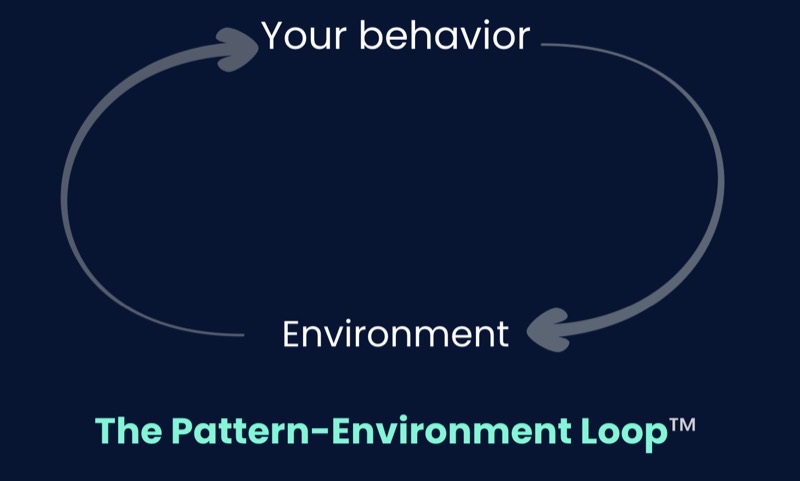
It’s really hard to break the Pattern Environment Loop, because your behaviors are inextricably linked to the environment. It’s like a strong magnetic bond that holds them together.
If you try to change your behaviors, the environment’s magnetic pull will cause you to revert back to your old behavioral ways.
Similarly, if the environment changes, your regular behaviors will cause the environment to conform back to their needs.
That’s the loop. Patterns shape the environment. The environment reinforces the patterns. And around it goes.
Want some examples of the Pattern Environment Loop?
I thought so.
Here you are.
—
The Smartest Person In The Room
Imagine a leader who succeeded by believing they are the smartest person in the room. They will inevitably build a culture where nobody else’s thinking matters as much as theirs. Their pattern – dominating intellectual conversations – shapes the environment. The environment – people defer to the leader – reinforces the pattern.
After a few years, they’ll call me because they’ll be frustrated that their team can’t think independently.
They think the problem is the team.
The problem is the Pattern Environment Loop.
—
The Fast Mover
Picture a leader who got promoted for his ability to move fast and make quick decisions. They will inevitably build a culture where everybody else feels useless. Their pattern – unilateral decision-making – shapes the environment. The environment – a team that’s learned to wait for the leader to make decisions – reinforces the pattern.
Inevitably I will get a call when the leader can’t figure out why nothing moves forward when they’re not in the room.
They think the problem is the team.
The problem is the Pattern Environment Loop
—
The Conflict Avoider
I’m sure you know a conflict-averse leader. It’s the person who wants everybody to like them and, in doing so, avoids the hard conversations. They will inevitably build a culture where bad news never surfaces in time to fix it quickly. Their pattern – avoiding hard conversations – shapes the environment. The environment – a culture of silence – reinforces the pattern.
They will call me at the point that they think their team doesn’t communication effectively.
They think the problem is their employees.
The problem is the Pattern Environment Loop.
—
See what I mean?
None of those leaders chose to create the bad environment. None of them even wanted that environment. That’s what makes the Pattern Environment Loop so difficult to break out of – it doesn’t feel like a trap when you’re the one on the inside. It actually feels like good leadership.
Why The Pattern Environment Loop Happens to Smart Leaders (Especially Them)
Here’s a crazy thing about the Pattern Environment Loop: it happens more to smart, successful leaders than to average ones.
It’s actually a lot like Imposter Syndrome in leadership. Your own success is what triggers the new challenges.
Think about women in leadership roles, for example. To climb the ladder, female leaders often have to be incredibly decisive, highly organized and fiercely dedicated. Those are amazing strengths – so when they use those skills, they get great results and everyone cheers them on.
But over time, those strengths turn into an identity. The leaders starts thinking “I’m the quick decision-maker” or “I am the one who keeps the high standards.“
It all sounds good. But when the team grows and the stakes get higher, doing everything yourself stops working.
But because the behavior is tied to who you are, it’s the last thing you think you need to change.
The leader who was always right doesn’t want to consider that being always right is now a problem.
The founder who built the company on instinct doesn’t easily accept that their instincts are now causing chaos.
The Pattern Environment Loop is most powerful when leaders feel most confident about their behaviors.
In fact, one of the more challenging tasks in leadership coaching, is to effectively tease out the behaviors that cause the difficult Pattern Environment Loop. Those behaviors are often hidden inside the leader’s strengths, not their weaknesses.
The 3 Places the Pattern Environment Loop Shows Up Most
After 25 years of working with leaders across industries, I’ve seen the Pattern Environment Loop manifest in three primary ways. These aren’t the only ways, but they’re the most common – and the most destructive.
The Capability Trap
The leader is an exceptional worker. They got promoted because of it. Now they lead people who do the same job – but the leader’s exceptional capability means they can always do it better than the people they’re supposed to be developing. So they do. Constantly. The team stops growing because the leader keeps rescuing them. The leader gets busier. The team gets less capable. The leader gets busier. And the Pattern Environment Loop tightens like a noose.
The Control Trap
The leader built something by staying close to everything. Their attention to detail, their involvement in every decision, their insistence on superior quality – these things were essential early on. Now they lead an organization of 200 people and they’re still behaving as if personal proximity to every decision is what is required to make things good. The organization revolves around the leader. Nothing happens without their involvement. And they wonder why they can never take a real vacation. The Pattern Environment Loop tightens even more.
The Harmony Trap
The leader values relationships. They’re good at reading rooms, managing dynamics, and keeping people happy. Those skills are genuinely valuable. But the skillset also involves avoiding hard conversations. The leader is focused on smoothing over the tensions and pretending they are all a unified group. But suddenly the culture becomes really toxic. People don’t get along. The Pattern Environment Loop has taken over.
Why You Can’t Break the Loop From Inside It
When it comes to recognizing the Pattern Environment loop, there’s a problem. A big problem.
It’s really hard to diagnose your own Pattern Environment Loop.
Not because you’re not smart enough. I’m going to assume you are.
It’s because the pattern IS your operating system. You see the entire world through the lens of your identity. It’s not a thing you have – it’s a thing you are (at least until someone helps you see it differently.)
This is also why high performers often spend less time on self-awareness. The person who’s struggled through their career has been forced to examine their patterns. But the high performer – the one who continues to succeed – has patterns the have worked well for so long, they’ve never had a need to examine them.
Diagnosing your Pattern Environment Loop goes a heckuva lot faster – and is usually more accurate – when you have an outside perspective that can see things clearly. Not because outside perspectives are smarter, but because they’re outside your loop. Because they aren’t looking at your Pattern Environment Loop through your eyes, they can see what the pattern is doing to the environment in a way that you will have a much more difficult time doing.
That’s where the Leadership Diagnostic Workshop comes in.
In 90 minutes, you will discover the specific patterns that are running your Pattern Environment Loop.
You will unlock your Unconscious Operating System and see yourself from a completely different perspective.
You will walk away with a very different understanding of what’s been happening with your career, and what is actually possible when the pattern changes.
It’s free. It’s 90 minutes. And it will change everything for you.
Frequently Asked Questions
Q: What is the Pattern Environment Loop?
The Pattern Environment Loop is the phenomenon where a leader’s unconscious behavioral patterns shape the environment around them – and that environment then reinforces the patterns. The result is a self-sustaining system that produces predictable outcomes regardless of how hard the leader works or how talented the team is. Breaking the Pattern Environment Loop requires identifying the pattern first, which almost always requires an outside perspective.
Q: How do I know if I’m stuck in a Pattern Environment Loop?
The clearest signal that your stuck in a Pattern Environment Loop is when the same problem keeps showing up, despite your best efforts to address it. If you’ve had the same conversation three times, if the same friction recurs with different people, if you just can’t seem to turn your team’s behaviors around – those are all the symptoms of an unconscious pattern that you need to address.
Q: Can you break the Pattern Environment Loop on your own?
Rarely. The challenge is that the pattern IS the lens you think through. You can notice symptoms of the Pattern Environment Loop. You can see the recurring problems, the gap between your intention and your action – but tracing it all back to the underlying pattern almost always requires someone outside the loop. A coach, a trusted advisor with no stake in your ego, or a structured diagnostic process can see what you can’t. Like the Leadership Diagnostic Workshop.
Q: Is the Pattern Environment Loop always negative?
No. Some loops are positive. For instance, a leader who genuinely develops people creates an environment that attracts people who want to grow, which reinforces the development culture. But even positive loops can become limiting if the environment outgrows the pattern. The question isn’t whether you have Pattern Environment Loops. You do. Everyone does. The question is whether your are still serving you and your organization at the stage you’re in.
Related Articles
- The Pattern Spotter: Why Leaders Repeat the Same Mistakes
- Leadership Blind Spots: What You Can’t See Is Running Your Team
- My Team Is Underperforming (And I Might Be Why)
- What Is a Leadership Diagnostic (And Why It Starts With 90 Minutes)
Jeff Matlow is a leadership coach, mentor and 3x entrepreneur who helps senior leaders spot the unconscious patterns keeping their teams dependent on them – then redesign the environment so everyone can actually perform. He’s spent 25+ years working with leaders at Disney, Porsche, Nestlé, and hundreds of high-growth companies. Think Ted Lasso meets Brené Brown meets a Navy SEAL. Learn more about working with Jeff or subscribe to The Best Leadership Newsletter Ever.